Know which changes to your site actually worked.
Growth Radar reads Search Console and Bing for each of your sites, tells you what to fix next, and grades every fix 28 days after it ships: Won, Lost or Flat.
Start with a free audit of your site. No signup.
Create a free account to have every site tracked weekly and every fix graded. Free during early access, no card.
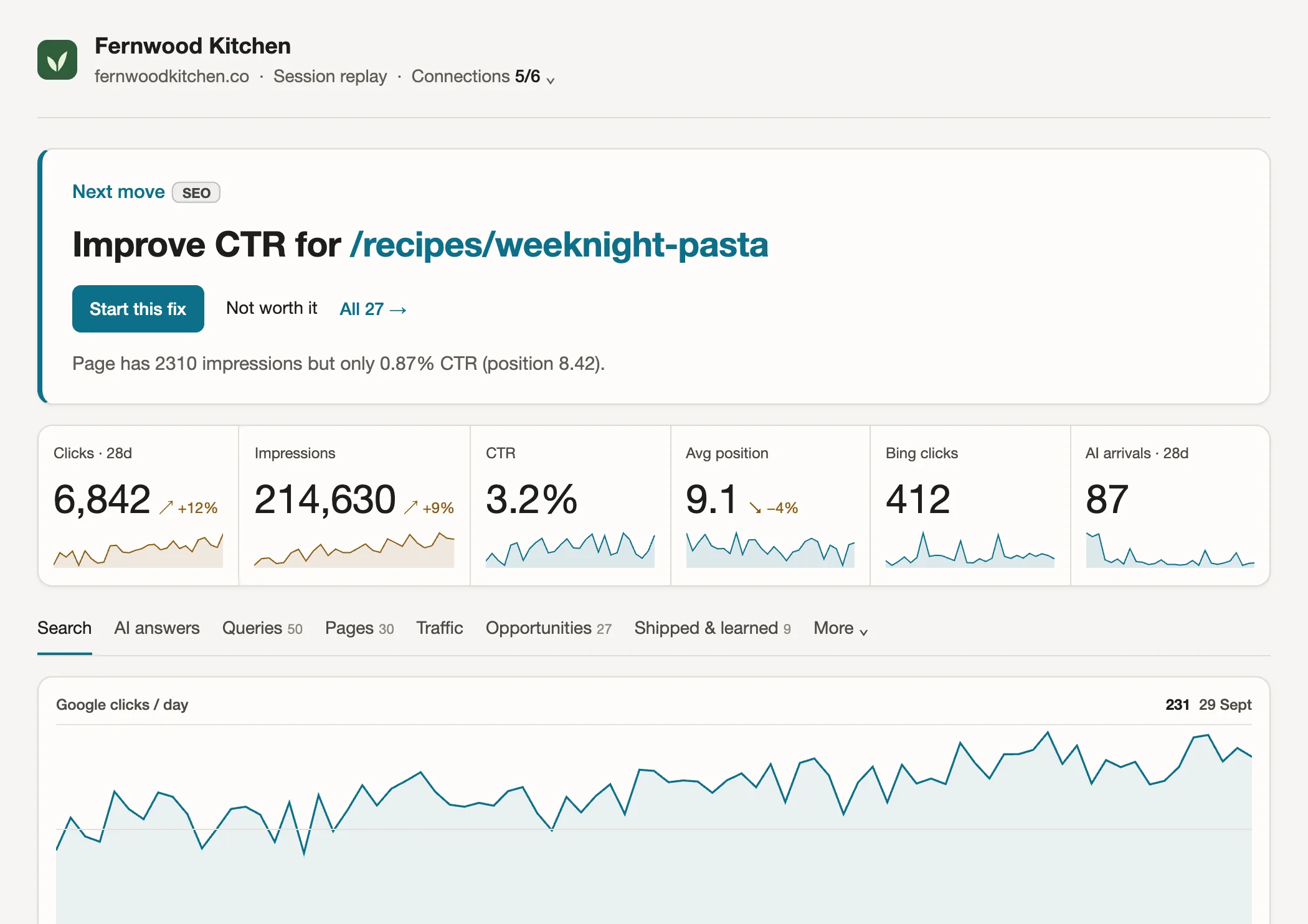
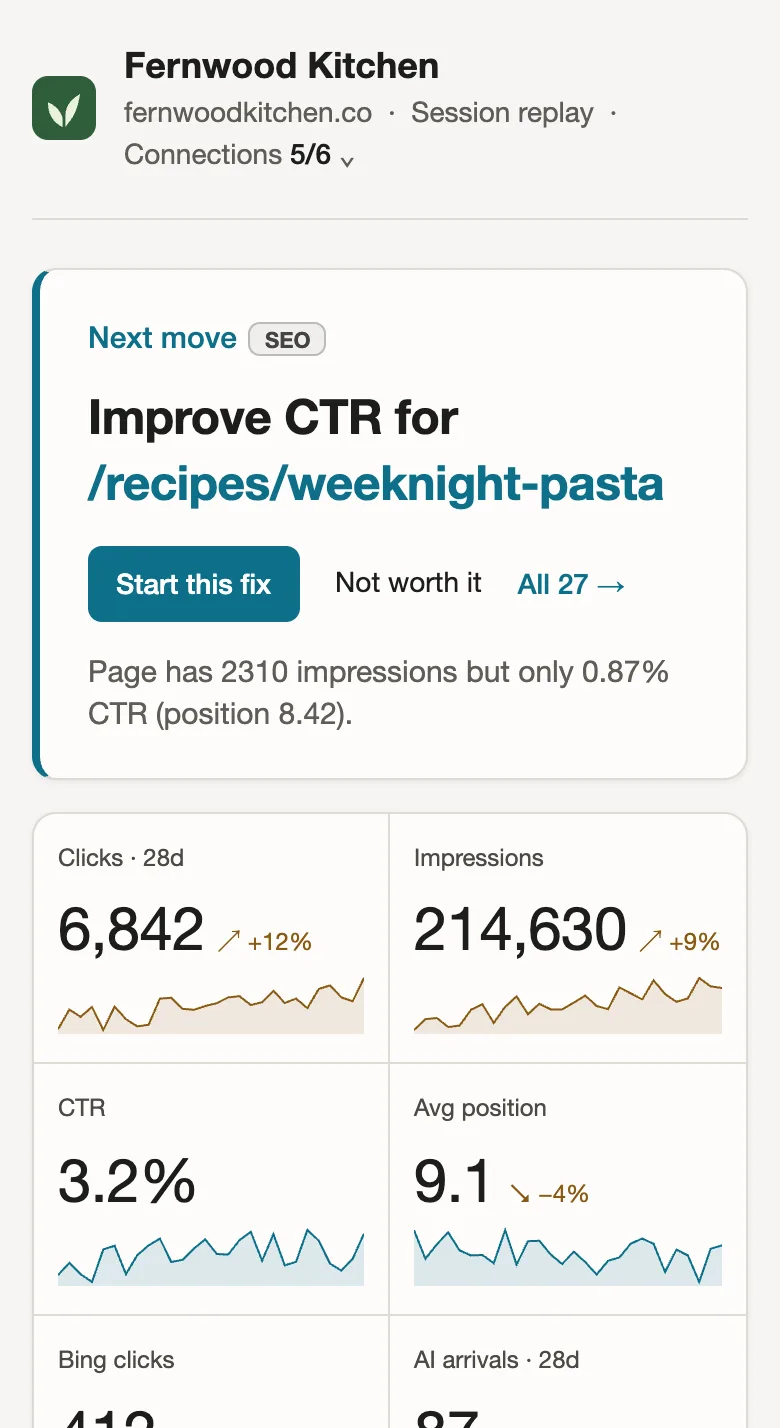
- of 7 fixes graded in the sample portfolio, losses shown
- 5 won · 1 lost
- sites in the sample portfolio
- 6
- Google impressions across them, last 28 days
- 318,406
From connected to graded in four steps
Search Console tells you a number moved. Growth Radar tells you what to do about it, then checks whether doing it helped.
- 1
Connect Google and Bing
Add your Search Console properties and a Bing Webmaster key. Nothing to install on your site.
- 2
See what moved and what to do
One page per site, refreshed daily: the queries and pages that moved, what dropped out, and fixes ranked by the clicks at stake for the work each takes.
- 3
Ship a fix, mark it shipped
Tell Growth Radar what you changed, or let it open the pull request. It records the baseline that day.
- 4
Get the grade at 28 days
Same metric, same pages, four weeks later: Won, Lost or Flat, or Inconclusive when the data cannot tell. Visibility in AI search is graded the same way.
Run a small business? We rebuild the site too.
A faster, clearer website, then Growth Radar watching it every week: speed on phones, Google and Bing traffic, and whether ChatGPT mentions you.
Every fix graded. Losses included.
A sample portfolio of six sites, graded the way your fixes will be. The numbers are illustrative; the grading rules are the real ones.
Fernwood Kitchen · Structured data · a graded fix from the sample portfolio
Add Recipe structured data with cook time and rating to the recipe index
Won+50%CTR
- CTR, 28 days before
- 1.38%
- CTR, 28 days after
- 2.07%
- Shipped
- 26 Jun 2026
- Graded
- 24 Jul 2026
Across the sample portfolio, 7 fixes have been graded: 5 won, 1 lost, 1 flat. 3 more are still inside their 28 days.
2 more fixes were left out: no measured baseline, or no data to grade on. Your own fixes are counted by the same rule.
Graded fixes, a loss among them
- Won
Tidewell Outdoors · Title rewrite
CTR 1.10% → 1.90%
+73% - Won
Quillstone Notes · Structured data
Impressions 9,420 → 13,180
+40% - Won
Brightloop Fitness · Content
Position 14.8 → 9.6
−35% - Lost
Marrow & Co · Title rewrite
CTR 2.40% → 2.05%
−15%
What Search Console and Bing don't do on their own
Both are free and both are good at reporting. Neither remembers what you changed.
| Feature | Growth Radar | Search Console + Bing |
|---|---|---|
| Clicks, impressions, CTR and position | Yes | Yes |
| Google and Bing in one place | Yes | Two separate tools |
| What moved, across every site, on one page | Refreshed daily | One property at a time |
| Fixes ranked by the clicks at stake for the work each takes | Yes | No |
| Baseline recorded the day you ship | Yes | Compare date ranges by hand |
| Every fix graded after 28 days, Inconclusive when the data cannot tell | Yes | No |
| Citations in AI answers graded the same way as clicks | Yes | Bing reports them, nothing grades them |
Questions
The things you would reasonably ask before handing over your Search Console.
Is Growth Radar another rank tracker?
No. A rank tracker tells you a number moved. Growth Radar records the change you deliberately shipped, the metric it was supposed to move, and the value at ship time, so it can tell you whether the work paid off, per kind of change, across every site you own.
How do I connect Google Search Console?
Sign in to Google from the connect screen and grant read-only Search Console access. Growth Radar lists the properties that Google account can see, you pick the ones to track, and the last 28 days import straight away. GA4 is a separate, optional consent from the same Google account. Disconnecting revokes the grant at Google. If Google access is not switched on yet, the connect screen says so and Bing still works. Search Console data trails real time by two to three days.
How do I connect Bing Webmaster Tools?
Paste a Bing Webmaster API key (in Bing Webmaster Tools: Settings, then API access). Bing has no API that issues the key, so it has to be pasted. Growth Radar checks the key against Bing before storing it, then lists your Bing sites to pick from. A site not on Bing yet can be imported there from Search Console. Several AI assistants retrieve from Bing's index, so it matters beyond Bing itself.
Do I get a weekly email?
Yes. Every Monday morning, in your time zone, a digest of what changed on each site, ranked by the clicks at stake, with the fixes to make next. A sharp drop in clicks sends its own alert. You choose the recipients and can unsubscribe from either in one click.
What does the free audit check, and what does it not?
It reads your homepage, robots.txt, llms.txt and sitemap the way an AI crawler does, as served and without running JavaScript: whether GPTBot, OAI-SearchBot, ClaudeBot, PerplexityBot and Google-Extended may read the site, which JSON-LD types are present, and whether the title, description, canonical and Open Graph tags are set. It does not see your rankings, your clicks or whether AI answers already cite you. That needs Search Console and Bing, which is what the product connects to.
How does Growth Radar decide whether a change worked?
When a fix is marked shipped, or its pull request merges, it records the metric the fix was meant to move (clicks, CTR, position, impressions, broken links or AI citations) for the pages it touched, over the 28 days before. Until 28 days have passed the verdict is too early. Then it measures the same metric over the same pages again, and over the most similar untouched pages of the same site. The change is a win when it beats at least 95% of them and moves at least 10% more than they typically do, a loss in the mirror case, and flat otherwise. When the test was too weak to tell a real change from noise, which on low-traffic pages is the usual result, or there was nothing comparable to check against, the verdict is inconclusive and counts nowhere. With nothing to measure it is no data, never a loss. For position, load time, errors and broken links, lower counts as better. A fix whose starting number was typed in by hand rather than measured is kept out of the headline counts.
How does Growth Radar track AI search?
In four ways, all narrower than a dedicated AI-visibility tracker. Bing's index is what several AI assistants read, so it reads Bing's own report of citations in AI answers. Once a week it asks a web-grounded model (Perplexity Sonar by default, through OpenRouter) the questions your site should answer and records which sites it cites. It reports GA4's AI-assistant traffic, which undercounts because most assistant visits arrive without a referrer. And it checks that each site serves llms.txt, an IndexNow key, and a robots.txt that lets AI crawlers in. A fix aimed at AI citations is graded the same way as one aimed at clicks.
What data does Growth Radar keep, and who can see it?
The aggregate reports each source returns: clicks, impressions, click-through rate and position per query and page, Core Web Vitals, and visit counts. No other account can see a site's data; every page and API call is scoped to the signed-in account, and the operator can access the database to run and repair the service. Google tokens and pasted API keys are encrypted with AES-256-GCM before they are stored, and are never shown again. To write findings, a site's top queries and aggregate numbers are sent to a model provider.
Does Growth Radar need access to my code?
Only for the shipping half; measuring works without it. Shipping uses a fine-grained GitHub token with Contents and Pull requests write access, scoped to chosen repositories. Every change passes an allowlist of paths for its kind of fix, and anything touching authentication, payments, CI configuration, dependencies or secrets is refused outright. Growth Radar opens pull requests. It cannot merge them.
How does the waitlist work?
Invites go out in line order. Each person who joins with your link and confirms their email moves you up 5 places (aliases of one mailbox count once; at most 2 per company domain, 5 a day and 20 in all). An unconfirmed signup does not count, and neither does your own address.
Is Growth Radar free?
Yes, during early access. Join the waitlist with an email address; no credit card is needed, and accounts open by invite. A paid plan will come later, and its price will be published on the pricing page before anyone is charged.
Who is behind Growth Radar?
Ohad Fisher, building it because he needed it to see which of his own site changes actually paid off. The example sites and numbers on this page are illustrative.
Get early access
The invite gets you the app on your own sites, free during early access. Invites go out in line order. Your place in line and a personal referral link come by email. Each person who joins with your link and confirms their email moves you up 5 places (aliases of one mailbox count once; at most 2 per company domain, 5 a day and 20 in all).